

You’re probably still enjoying the Christmas tree in your home, at least for another week, but what can you do with it afterwards? Many people wonder if their Christmas tree can enjoy a second life outdoors, and the short answer is yes. You can plant a Christmas tree in your garden, but there are a number of factors to consider, so that you get the best possible outcome.
Choosing the right type of Christmas tree to plant in your garden
Your chances of success depend largely on whether your Christmas tree is living or cut. Only a living tree with an intact root system can be planted. These are typically sold in pots or containers and are often labelled as “pot-grown” or “container-grown”. A cut tree, even one with a short stump attached, will not regrow once it has been severed from its roots.
Even among living trees, quality matters. A pot-grown tree that has been cultivated in the same container for several years will establish more easily than one that has been dug up and placed into a pot shortly before sale. You can usually tell the difference by gently checking the root ball. If roots are visible and hold the compost together firmly, the tree is more likely to settle well.
Do I have enough space to plant a Christmas tree in my garden?
Before planting, you should consider the eventual size of the tree. Many popular Christmas trees, such as Norway spruce, Nordmann fir and blue spruce, can grow well over 10 metres tall and several metres wide. In a small or medium-sized garden, this can quickly become impractical.
You should assess whether you have enough space not only for the tree itself, but also for its impact on light levels, neighbouring plants, buildings, and boundaries. Roots can spread widely, and mature trees may cast dense shade. If space is limited, you may prefer a slower-growing or smaller species, or keep the tree permanently in a large container.
Timing and planting conditions
The best time to plant a Christmas tree is while it is dormant, usually between late autumn and early spring, provided the ground is not frozen or waterlogged. If you have kept the tree indoors for Christmas, it is important to limit its time inside. Ideally, it should not spend more than 7 to 10 days in a warm environment.
Before planting, you should allow the tree to acclimatise. Place it in a sheltered, cool area such as a porch or unheated garage for a few days to help it adjust gradually to outdoor conditions.
This reduces stress and improves its chances of survival.
When planting, choose a spot with adequate light and good drainage. Most Christmas tree species prefer full sun to partial shade and soil that does not remain wet for long periods. Dig a hole slightly wider than the root ball, but no deeper. The tree should sit at the same soil level it was growing at in its pot.
How to look after a Christmas tree in the garden
Once planted, ongoing care is essential to help your Christmas tree establish and thrive.
- Watering and mulching: In the first year, regular watering is crucial, especially during dry spells. You should keep the soil consistently moist but not waterlogged. Newly planted trees have limited root systems and can dry out quickly, even in cooler weather.
Applying a layer of organic mulch, such as bark chips or compost, around the base of the tree will help retain moisture, regulate soil temperature, and suppress weeds. Keep mulch a few centimetres away from the trunk to prevent rot. - Defining the planting area: It can be helpful to clearly define the planting area around the base of your Christmas tree. Installing garden edging around the tree creates a distinct border that keeps mulch in place, prevents grass and weeds from encroaching, and makes mowing or strimming easier without risking damage to the trunk. A neat, defined edge also helps the tree feel like a deliberate part of the garden design as it grows, rather than an afterthought.
- Feeding and soil care: In most cases, a Christmas tree does not require heavy feeding. However, if your soil is poor, you may apply a balanced, slow-release fertiliser in spring. Avoid high-nitrogen feeds, which can encourage excessive soft growth that is more vulnerable to pests and frost damage.
Good soil structure is more important than fertiliser. If your garden soil is heavy clay or very sandy, improving it with organic matter before planting will benefit long-term health. - Protection and pruning: Young trees may need protection from strong winds, frost, or wildlife. In exposed locations, you may stake the tree loosely for the first year to help it establish. Ensure ties are not too tight and are checked regularly.
Pruning is rarely necessary in the early years. Most Christmas trees naturally form an attractive shape. If you need to remove damaged or crossing branches, do so lightly and ideally in late winter or early spring. - Long-term management: As the tree matures, you should monitor its size and condition. If it outgrows its space, professional advice may be required. Some species respond well to careful height control, while others do not tolerate heavy pruning.
You should also be mindful of local regulations. In some areas, large trees near boundaries or buildings may require consideration to avoid future disputes or safety concerns.
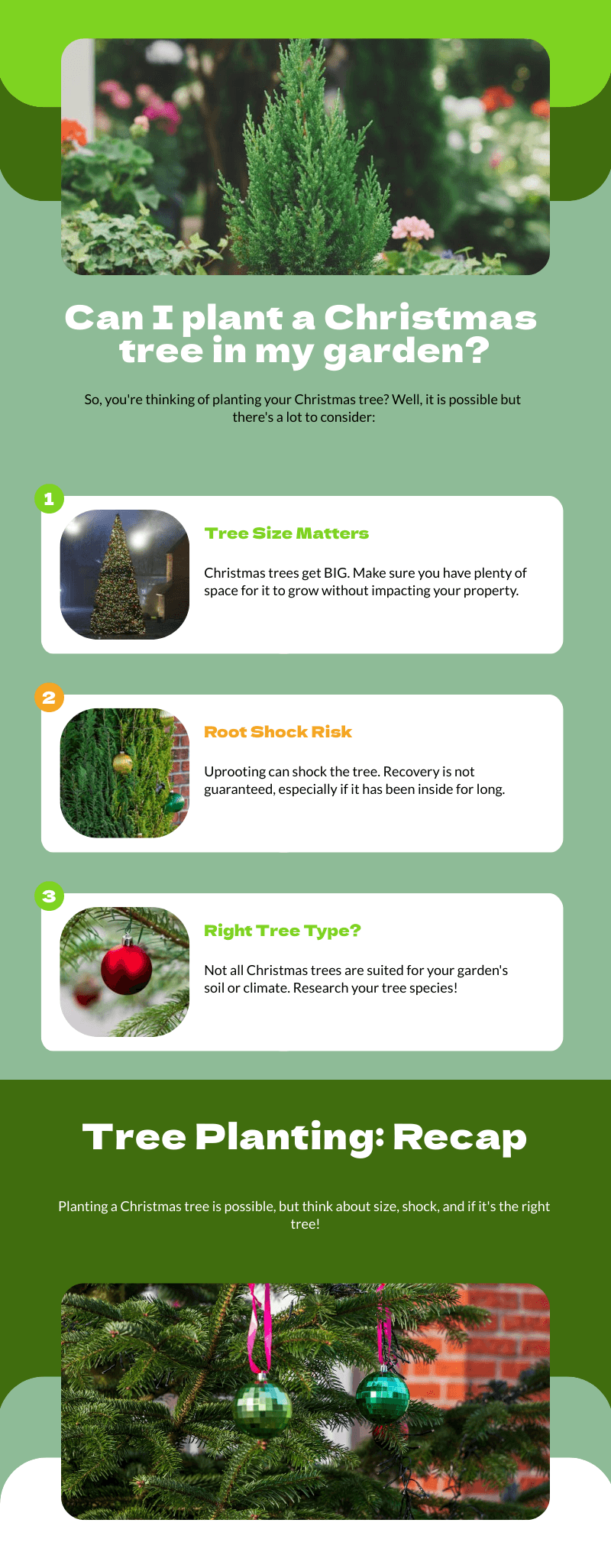
So, can I plant a Christmas tree in my garden?
If you have the right type of tree, enough space, you prepare your garden thoughtfully, and commit to ongoing care, you can plant a Christmas tree in your garden, and give it the opportunity to flourish for years to come.
