


Garden edging is the perfect way to refresh your space and keep it organised. In this blog, we’re going to let you know how to measure a garden border for edging and calculate how much you need.
Before you hit purchase on your garden edging solution, it’s crucial to complete the right preparation, including getting accurate measurements for the space. Otherwise, you risk not having enough edging and waiting for more to arrive, or buying too much and dealing with returns.
FlexiBorder is an excellent rubber edging solution for those wanting to create neat, defined garden borders. It can also be used for commercial spaces, such as hotel gardens, schools and even play areas. Read our blog on garden edging for schools, nurseries and commercial spaces.
Our rubber edging solution is highly durable and suitable for every garden regardless of shape or size. Our FlexiBorder product can bend up to 70° to accommodate curves in your garden. We also have FlexiCorner, which is designed to provide 90° angles, perfect for corners in your garden.
Measuring your garden for edging
Step 1: Decide where the edging is going
Many people choose to use edging in multiple areas of their garden, including around paths, patios, driveways, flowerbeds and even other focal points. With this in mind, you may need a few different sections of edging. Before you get started, decide exactly where you want the edging to sit.
Some people find it helps to visualise the edging in place, and you can do this by placing string, using a hosepipe, or spraying lines in the grass.
Step 2: Measuring your garden borders
The process for measuring your garden borders varies depending on the area you are dealing with. For example, if you have a straight garden border, it’s reasonably simple, as you just need to measure the full length using a tape measure.
If you have curved borders, the best thing to do is follow the curve with a flexible tape measure or a garden hose, and then measure. Make sure the border is curving exactly where you want it to for the most accurate results.
If you have irregular-shaped borders, you might find it easier to break the border into smaller, more manageable sections. Measure each of the different areas separately in line with how you’d like the border to sit.
Step 3: Calculate how much edging you need for your landscape
Once you’re feeling happy and confident with your measurements, you can calculate how much edging you need. Simply add together the measurements you have for all of the sections to get your total length needed.
Depending on your measurements, you may need to complete some simple conversions: 1 metre converts to 100cm.
For a medium-sized garden with a lawn, a flower bed running along the back fence and a border down one side, you may measure this in three sections.
- Straight border along the back fence: 5 metres
- Border along the side of the lawn: 4 metres
- Curved section around a flower bed: 2 metres
Total edging needed: 5m + 4m + 2m = 11 metres
To allow for joins, adjustments and small measuring inaccuracies, add approximately 10% extra: 11m + 1.1m = 12.1 metres
In this example, purchasing around 13 metres of Flexiborder would give you a little extra to work with.
Step 4: Allow for joins, corners and extra length in edging products
As mentioned above, measurements can sometimes be inaccurate, and you also need to account for joins and adjustments. We recommend ordering slightly more FlexiBorder than you actually need to account for these changes.
To reduce the risk of inaccurate measurements, you might choose to measure the area twice. Accurate measurements can limit waste and reduce the risk of running short on edging.
Step 5: Choosing the right amount of FlexiBorder
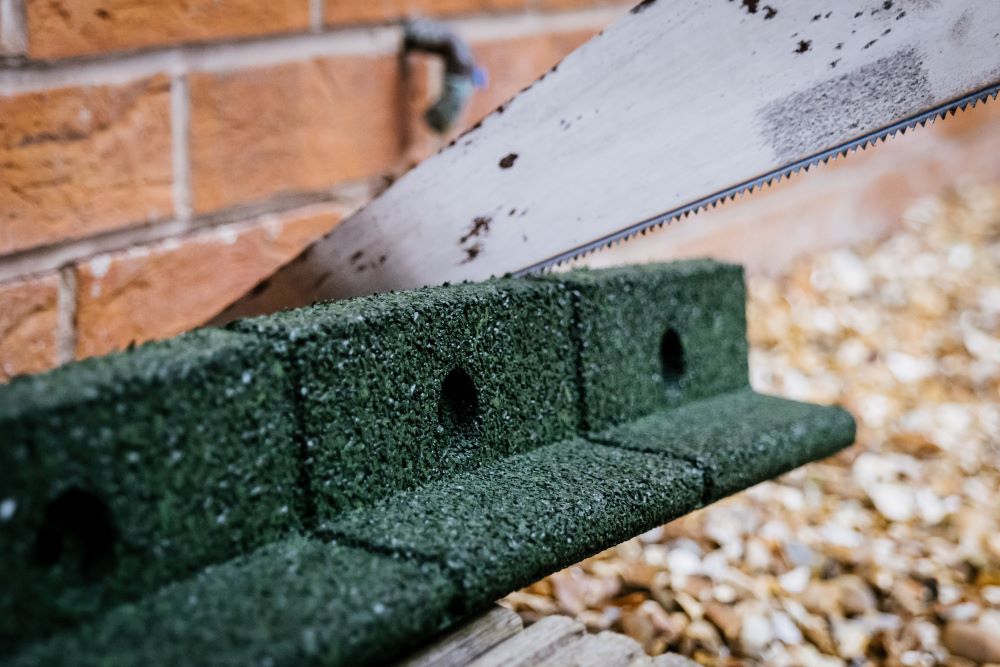
FlexiBorder pieces are sold as 1 metre long and approximately 80mm high and 80mm wide, and weigh 2.6 kg. FlexiBorder can be cut using a suitable saw if you need a custom length to complete your project.
You should also consider the finish that you’d like for the border, as it can be installed flush with the ground or with some edging exposed to create a more defined border area. Read our blog on how deep garden edging needs to be.
For FlexiCorner, both the inside and outside corners are designed for 90° angles. They are manufactured to the same height and profile as standard FlexiBorder. Each side of the corner measures approximately 7 inches (178mm) from the centre of the bend, allowing it to connect seamlessly with standard FlexiBorder sections using the supplied connector pins.
Choosing FlexiBorder
Using FlexiBorder and FlexiCorner means you can adapt your edging to any angle thanks to its incredible flexibility.
In addition to being highly flexible, it is durable and can withstand harsh weather conditions. It is available in a range of colours to suit your garden aesthetic.
We hope this blog has been helpful in measuring your garden edging. It’s important to measure the space accurately so you can achieve a professional-looking garden edge.
Head over to our FAQs to see if there’s anything else you need to know before ordering, and check out our case studies to see how other people have used FlexiBorder. Please don’t hesitate to contact us if you have any questions. We will be more than happy to help.