


Want to give your garden a new lease of life? Perhaps you’re thinking about redesigning the layout or changing up the shape? Whatever you’re planning, don’t forget the finishing touches, like garden edging. In this blog, we’ll explore rubber, metal, wood and plastic garden edging to help you choose the best option.
What is garden edging and what can it be used for?
Garden edging separates different areas of a garden, but it can also be used on playgrounds and other commercial outdoor spaces. Garden border edging comes in a range of materials and colours, so you can choose options that fit your overall aesthetic.
People often use it around flowerbeds, borders, trees, play areas, and other focal points in an outdoor space. You can use it for pathways or to indicate places where you do not want people to walk.
In some cases, garden edging can help limit grass and weeds creeping into borders, while keeping mulch and soil contained in the right areas.
With so many materials to choose from, consider durability, appearance, maintenance needs, sustainability and your budget before you decide.
Rubber vs metal vs wood vs plastic garden edging
| Feature | Rubber edging | Metal edging | Wooden edging | Plastic edging |
| Lifespan | Long-lasting; resistant to rot and designed for outdoor use | Very long-lasting, depending on metal type | Can deteriorate through rot and moisture | Varies; can become brittle or crack over time |
| Cost | Moderate; good long-term value | Moderate to high | Low to moderate | Usually low |
| Flexibility | Highly flexible; ideal for curved borders | Generally rigid, though some types bend | Mostly rigid | Flexible options available, but quality varies |
| Appearance | Neat, practical and versatile | Sleek, modern and minimalist | Natural, rustic and traditional | Simple and functional |
| Maintenance | Low; little upkeep required | Low, though some metals may rust | Higher; may need treating or replacing | Low, but damaged sections may need replacing |
The pros and cons of each garden edging material
Rubber garden edging
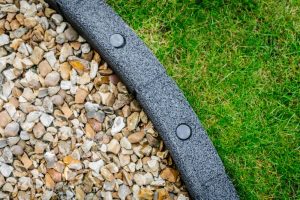
Rubber garden edging is flexible, durable and ideal for curved borders. Our rubber edging also comes as FlexiCorner, designed for 90-degree angles so that you can use it for corners. FlexiBorder can curve up to 70 degrees, letting you create natural-looking curves in your garden design.
Rubber edging is often praised for its low maintenance and rot resistance. Our rubber edging products are designed to withstand everyday lawn maintenance. They are designed for outdoor use in different weather conditions, with secure fittings to help keep them in place.
Many homeowners choose rubber edging for its long-lasting performance and low maintenance. Its flexible construction makes it a practical option for family gardens.
Metal garden edging
Metal options, such as steel edging, can provide a long-lasting solution for your garden’s borders, but they can often be costly. Some metal edging is rigid and best suited to straight garden borders, although flexible options are also available for curved designs.
Metal edging creates crisp, well-defined borders and gives garden beds a sleek, modern look.
Wood garden edging
Wooden garden edging often looks good because it’s natural and traditional, perfect if your home follows this style.
While it is often seen as an affordable option, it can be susceptible to rot and weathering over time, so you may need to replace it more often than other options.
Plastic garden edging
Plastic border edging is praised for being lightweight and budget-friendly, but it can be more prone to damage than other alternatives. Depending on quality and exposure, plastic edging can become brittle and crack or fade.
Which lawn edging is best for your garden?
The best option for landscape edging depends on factors like cost, desired appearance, durability and other priorities.
Rubber edging often comes out on top due to its ability to create curved borders so easily – plus corners if you choose FlexiCorner.
Our wide range of colours lets you design your garden with a style in mind and keep it consistent across every aspect. As an affordable, low-maintenance option that suits both straight lines and curved designs, rubber edging is a fantastic choice.
If you’re not sure of the best option for you, why not order a sample? Order FlexiBorder for straight lines and curves and FlexiCorner for 90-degree angles.
What to consider before choosing garden edging?
- Your own budget
- The long-term value you get from your garden edging solution
- What layout you want in the garden for flower beds and paths
- Your aesthetic appeal
- Whether you need curved areas, corners or a combination of both
- Weather resistance
- Expected lifespan of the edging
- Installation requirements – installing FlexiBorder edging couldn’t be easier; no professional installation needed!
- Ongoing maintenance requirements
Why choose rubber garden edging?
If you’re looking for a flexible option that works with your garden’s layout instead of against it, consider FlexiBorder’s rubber edging.
Our edging is durable, long-lasting, and requires minimal maintenance. We provide full installation guidelines and secure pegs to pin it in place. FlexiBorder allows you to create tidy, defined borders with little to no maintenance.
Our range of colours looks great in any garden, and our products are made from recycled tyres, helping to reuse existing materials and reduce waste. Rubber is a practical alternative to many other materials.
When choosing between rubber, metal, wood, or plastic garden edging, the best solution depends on your needs.
If you’d like to learn more about our rubber edging solution, check out our case studies or contact our friendly team. We’ll be more than happy to help.